






There is no single proof that points out “The” oldest Hindu scriptures. But lakhs and lakhs of scriptures form the bedrock of Hinduism. There are some ancient Hindu scriptures and books that are fundamental across all Hindu philosophical thoughts and schools. So let’s take a look at some of the oldest Hindu scriptures and what they say:
Ancient Hindu Scriptures – The Srutis
Sruti is among the oldest Hindu scriptures, and it talks about eternal knowledge. It is God-revealed and passed to the ordinary people by rishis. These are eternal in nature and consists of four Vedas. Sruti also has the Samhitas, Brahmanas, the Aranyakas (the forest books), and the early Upanishads. The first two texts aids individuals in performing Vedic rituals, while the last two help in spiritual and contemplative practices.
The Srutis talk about fundamental principles essential for all individuals. It gives them a purpose in life, so much so that every religion has a sruti content of its own. Many regard srutis as the guide for Hindu law and culture.
Ancient Hindu Scriptures – Smrtis
The Smrti texts are a specific body of the oldest Hindu scriptures. Most Hindus have a greater familiarity with Smrti texts. We consider Smriti as less authoritarian when compared to sruti. The smrti is a vast corpus of diverse texts. They include the Vedangas, the Itihasas (Ramayana, the Mahabharatha), the Sutras and Shastras, Hindu philosophies, the Puranas, the Kavya, or poetic literature, the Bhasyas. It also consists of numerous Nibandhas (digests) covering politics, ethics, culture, arts, and society.
Smrtis are human-made, passed down across generations, according to the needs of the time. It refers to the codes of conduct outlined in texts like Manusmrti, which would guide generations of humans to come.
Vedas
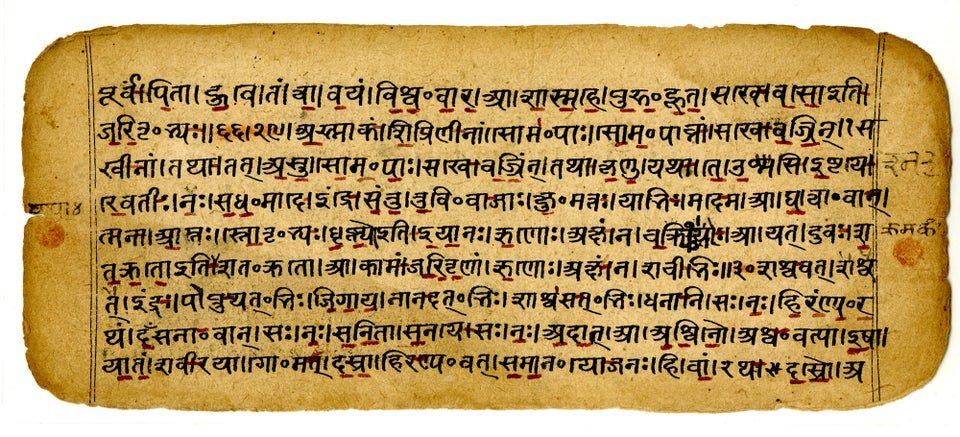
Now, are you wondering where Vedas stand among all the ancient Hindu scriptures? The Vedas are considered to be the oldest texts in Hinduism. The word comes from the root word ‘vid,’ which means ‘to know.’ Hence, the literal meaning of Veda is ‘the book of knowledge.’ It is a collection of sacred verses as well as secular knowledge.
Vedas are scriptures in essence as they are a set of holy writ concerning the Divine’s nature. But unlike scriptures of other religions, the Vedas were not revealed to a particular individual at a specific historical time. Hinduism states that Vedas came into existence in the minds of sages in deep meditative states. Passed down from master to student orally for generations, it finally got penned down between 1500-500BCE in India. It is the reason why Hinduism regards Vedas as sruti.